
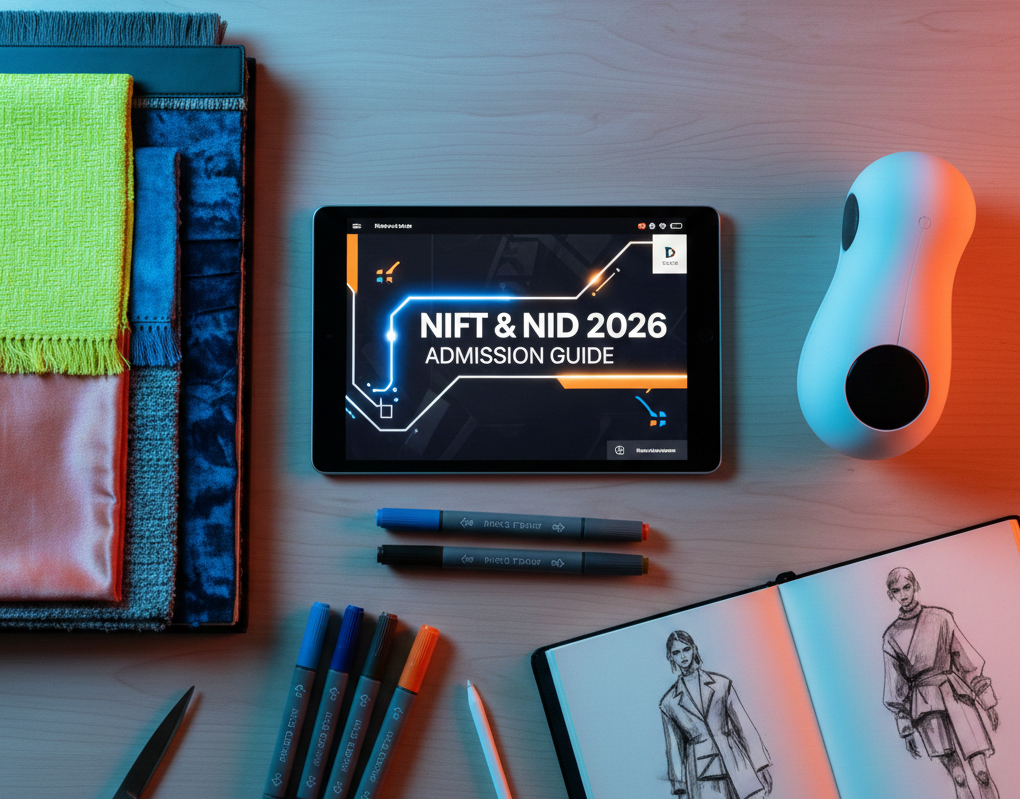
There comes a quiet moment after Class 12 when the noise of expectations fades for a second, and you ask yourself a real question: What kind of life do I want to build? Some choose engineering, some medicine, some commerce, and then there are those restless dreamers whose notebooks are full of sketches, color ideas, product concepts, fashion silhouettes, and stories told through design. If you’re here, chances are your heart beats a little faster when creativity meets possibility.

A design career isn’t just about drawing pretty things. It’s about understanding people, solving problems, shaping experiences, and creating something meaningful in the world. And in India, two of the most respected doors into this world are NIFT and NID. Every year, thousands of students step into the journey of NIFT, NID admission after 12th, hoping to turn imagination into profession.
But the path can look confusing at first. Entrance exams, preparation, portfolios, deadlines, courses, campuses, it’s a lot. So, let’s slow down, breathe, and walk through this guide.
Why Design Is Becoming a Powerful Career Choice After 12th
Earlier, creative careers were often treated as hobbies rather than serious professions. Parents worried about stability, and students felt pressured to follow conventional paths.
Every product you use, every app interface you swipe through, every garment you wear, every advertisement you notice, all of it is shaped by designers. Businesses today survive not just on function but on experience and storytelling. Personal experience holds equal value as skill set.
Choosing a design career after 12th means entering fields like fashion design, product design, animation, UI/UX, textile design, communication design, and more. It means building a career where your curiosity matters as much as your marks.
And institutes like NIFT and NID are among the best places to start that journey.
Understanding NIFT and NID: What Makes Them Special?
NIFT focuses strongly on fashion and lifestyle-related design fields. From fashion design and textile design to fashion communication and accessories, it prepares students for industries connected to fashion, retail, and lifestyle branding.
NID, on the other hand, is known for broader industrial and communication design disciplines- product design, animation, film, graphic design, and more. It’s famous for encouraging deep thinking, experimentation, and problem-solving.
Both institutes are respected globally, and getting admission into either is competitive. Both of them have their own set of challenges.
Who Can Apply After 12th?
The good news? Students from any stream — Science, Commerce, or Arts — can apply. Your creativity matters more than your subjects.
Eligibility generally includes:
• Completion of Class 12 or appearing in board exams
• Age limits depending on category (usually around early twenties)
• Willingness to prepare seriously for entrance exams
You don’t need to be a perfect artist. You need curiosity, observation skills, and willingness to learn.
NIFT Admission 2026: What You Should Expect
The process for NIFT admission 2026 usually includes two stages:
1. Written Entrance Test
This tests creative thinking, logical reasoning, general knowledge, and problem-solving ability. It is not about memorising books, but using your creative thinking under time pressure.
2. Situation Test or Studio Test
Shortlisted candidates are asked to create models or solutions using given materials. Here, imagination and neat execution matter more than perfection.
The key is practice. Many students panic during creative tests because they haven’t trained their minds to think visually within time limits. Practice is everything.
NID Admission 2026: How It Works
The NID admission 2026 process usually involves:
1. Design Aptitude Test (DAT Prelims)
This checks observation skills, creativity, visual thinking, and problem-solving.
2. DAT Mains
Shortlisted students face studio tests and interviews. Here, communication, creativity, and how you approach problems become important.
NID questions often feel open-ended. They want to see how uniquely you think rather than how much you remember.
Preparation: When Should You Start?
One big myth is that toppers prepare from childhood. Reality check- many successful students begin serious preparation 6–12 months before exams. It depends on your dedication and will to practice.
Starting early helps, but what matters more is consistent effort. Daily sketching, observing everyday objects, improving visualization skills, solving past papers, and building awareness about design trends slowly sharpen your thinking.
Preparation doesn’t mean locking yourself in a room. Go outside. Observe markets, public spaces, advertisements, clothing styles, product packaging. Observation plays a major role in a designer’s life.
Do You Need Coaching for NIFT & NID?
Coaching can help with structure, guidance, and practice. But it isn’t magic. Some students clear exams through coaching; others succeed with self-study and discipline.
If coaching motivates you and fits your budget, it can be useful. But remember: success ultimately comes from personal effort, not just classes.
Coaching is nothing if you don’t do self-study at all. Sometimes self-study becomes difficult without coaching, therefore both go hand in hand.
Portfolio and Creativity: What Really Matters?
Many students think they need a professional portfolio right after 12th. Actually, entrance exams focus more on raw thinking ability than polished portfolios. Still, maintaining a sketchbook helps. Capture daily observations — people, products, environments, ideas. Over time, this builds creative confidence.
Designers are storytellers. Learn to explain why you created something, not just what you created. Portfolio is your 1 part of preparation for a good design college but what will lead to good portfolio is creativity.
Career Opportunities After NIFT or NID
Graduating from top design institutes opens doors to diverse careers:
• Fashion Designer
• Product Designer
• UI/UX Designer
• Animator or Game Designer
• Communication Designer
• Textile Designer
• Creative Director
• Entrepreneur or Brand Founder
The design world rewards originality. Many graduates start their own labels or studios, blending creativity with business skills.
Mental Preparation: Handling Pressure and Expectations
Entrance preparation can feel overwhelming. There will be days when ideas refuse to flow, sketches look terrible, and mock test scores disappoint you. That’s normal. You need to prepare yourself to go through turmoil of emotions, it will happen but you will also be able to cope up.
Design is not about being perfect every day; it’s about showing up anyway. Even great artists have rough drafts. Keep practicing, keep learning, and trust the process. Sometimes, talking to seniors or watching designer interviews inspires more than books.
Final Thoughts: Turning Dreams into Direction
Standing at the crossroads after Class 12 feels like staring at a blank canvas. Scary, exciting, full of possibilities. Choosing the path of creativity requires courage, because society still celebrates predictable careers more.
If you’re exploring NIFT NID admission after 12th, it means something inside you wants to build, design, imagine, and shape the world. Respect that voice.
You just need that one click! Once u step in you will enjoy this journey of design prep. Emotions and thoughts will keep on flowing but you will understand the depth and meaning of these exams and why they test you.