A design portfolio is more than a collection of pretty sketches. It is a glimpse into the way you think, observe, experiment, solve problems, and turn an idea into something meaningful. For students preparing for design admissions such as NIFT, NID, and UCEED, building a portfolio can feel confusing at first. What should you include? How many projects are enough? Should your drawings be perfect? And most importantly, what actually makes a portfolio stand out?
Whether you are naturally good at sketching or still learning the basics, a thoughtful portfolio can help communicate your creative potential.
1. Start With Your Curiosity
The strongest portfolios often begin with something ordinary. Maybe you noticed how people struggle to carry multiple shopping bags. Perhaps you became curious about why a particular chair feels comfortable. You could be interested in Indian crafts, sustainable fashion, architecture, packaging, animation, photography, or even the way people interact with everyday objects.
These observations can become project ideas. Instead of trying to create projects simply because they “look impressive,” start by asking: What am I curious about?
Design is fundamentally about noticing things that others might overlook. Your portfolio should reflect that curiosity.
2. Show Your Process, Not Just the Final Artwork
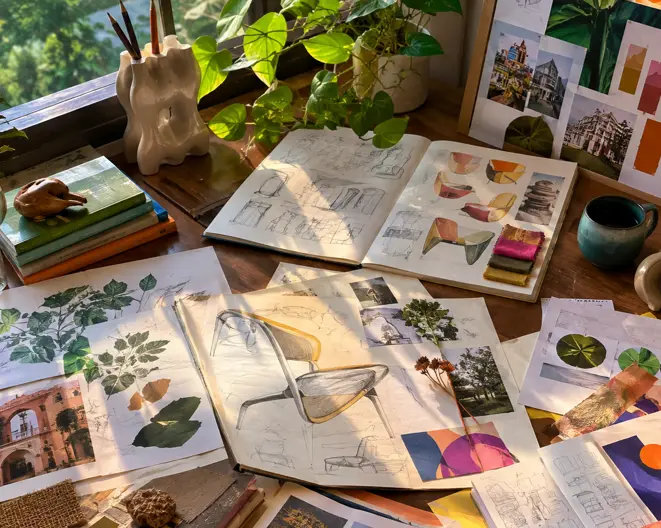
One of the biggest mistakes students make is filling their portfolio with only finished drawings or polished designs. A good portfolio should showhow you arrived at the final idea. For example, if you designed a chair, you could show:
- Your initial observation
- Rough sketches
- Different shapes and forms you explored
- Research and references
- Failed ideas
- Experiments with materials
- Your final concept
- The reasoning behind your design
Those rough sketches are not something to hide. They can actually make your portfolio more interesting because they reveal your thinking. Admissions are not only about seeing what you can draw. They are about understanding how you think like a designer.
3. Build Projects Around Different Skills
Your portfolio should have variety, but that doesn’t mean randomly adding everything you’ve ever created. Try creating projects that demonstrate different abilities. For example, you could include:
Observation: sketches of people, objects, spaces, plants, or everyday surroundings.
Problem-solving: a project where you identify a problem and develop a design solution.
Visual communication: posters, illustrations, storytelling, or graphic compositions.
Product thinking: concepts for everyday objects or user-centred products.
Material exploration: experiments using paper, cardboard, fabric, clay, recycled materials, or found objects.
Research: projects inspired by architecture, Indian art, crafts, culture, history, or contemporary design.
This gives your portfolio a sense of personality while showing that you are willing to explore beyond one medium.
4. Don’t Be Afraid of Imperfect Work
There is a strange pressure among design aspirants to make everything look flawless. But creativity rarely happens that way. A page filled with rough lines, crossed-out ideas, colour experiments, and alternative compositions can sometimes tell a more compelling story than a perfectly finished illustration.
Your portfolio doesn’t need to scream, “Look how perfect I am.”
It should quietly say: “This is how I observe. This is how I experiment. This is how I solve problems.”
That difference matters.
5. Add Personal Projects
Personal projects can give your portfolio something that standard coaching exercises sometimes cannot: your personality. You could document a local craft tradition, redesign something in your room, create an illustrated story based on an Indian folk tale, experiment with sustainable packaging, photograph interesting textures around your neighbourhood, or redesign an everyday object.
Don’t underestimate small ideas.
6. Learn to Explain Your Ideas
A beautiful project becomes much more powerful when you can explain why you made it. For every major project, consider including a short description covering:
The problem: What did you notice?
The research: What did you learn?
The exploration: What ideas did you try?
The solution: What did you finally create?
The reflection: What would you change or improve?
This turns your portfolio from a picture book into a visual story.
7. Practice Regularly
Portfolio building shouldn’t become a last-minute activity. Keep a sketchbook and make it part of your everyday routine. Sketch a cup on your desk. Observe a person waiting at a railway station. Draw an interesting building. Collect textures. Photograph shadows. Experiment with compositions.
Even 20–30 minutes of regular practice can gradually build your visual confidence.
For students preparing for NIFT, NID, and UCEED, this habit can also support entrance-exam preparation because observation, creativity, visualisation, and problem-solving are valuable skills across design education.
8. Get Guidance Instead of Working Completely Alone
Sometimes the hardest part isn’t creating a project, it’s knowing whether the project is actually communicating what you intended. This is where structured guidance can make a real difference.
At Design India Collective, students can work on the creative fundamentals behind design entrance preparation while receiving guidance on areas such as sketching, ideation, visualisation, design thinking, problem-solving, and portfolio development.
The advantage of learning in a structured environment is that you don’t have to figure everything out through trial and error. Feedback can help you recognise what is working, where your ideas need more depth, and how to present your work more effectively.
For students preparing seriously for design admissions, that kind of consistent feedback can turn scattered creative work into a much more cohesive body of work.
9. Curate Your Portfolio Carefully
More pages do not automatically mean a stronger portfolio. Think like a curator.
Choose work that represents your strongest ideas and demonstrates different aspects of your creativity. Remove repetitive pieces, unfinished experiments that don’t add value, and work that doesn’t represent your current ability.
Arrange projects in a logical order so that the portfolio feels like a journey rather than a random gallery.
And remember: presentation matters. Keep layouts clean, photographs clear, colours consistent, and explanations concise.
10. Let the Portfolio Sound Like You
Perhaps the most important rule is this:
Don’t create a portfolio that you think an admissions panel wants to see. Create one that genuinely represents you as a young designer.
You don’t need to imitate Pinterest portfolios or copy the aesthetic of successful candidates. Your interests, mistakes, experiments, observations, and ideas are what make your work different.
NIFT, NID, and UCEED preparation is not simply about becoming better at drawing. It is about developing the ability to observe deeply, think differently, communicate visually, and solve problems creatively.