

There is always a gentle beginning before a big dream. It never arrives loudly. It doesn’t knock with urgency. It usually slips in during ordinary moments — while doodling on the last page of your notebook, while arranging your room because it suddenly feels like it needs to “flow better,” while watching the way light falls on walls, or how colours change your mood. Somewhere inside, something whispers that you may be meant to build, imagine, shape, and create.
Soon after that whisper comes the question that feels heavier than it should — When should I really start preparing? After 10th? Or after 12th?
For design aspirants, this question can feel like a fork in the road. But the truth is softer, kinder, and much less rigid than most people make it sound. It is much easier than it feels.
NIFT, NID and UCEED are not just entrance exams. They are gateways into a life where your ideas matter, your sensitivity matters, and your way of seeing the world becomes your profession. And because design grows from within, the “right time” to begin is not just about age — it is about awareness. It is about your self-decision and realisation about your skills, and your confidence within your own abilities and skills. It is a decision for a student to make on their own after all.
Understanding What These Exams Actually Look For
These entrances are not built on memorisation or repetition. They are not impressed by who started first or who solved the most mock papers. They look for something quieter and deeper — your ability to observe, to connect ideas, to think differently, to express visually, and to feel the emotional weight of everyday life. It tests your sincerity towards your goals and work and how you implement your thoughts and emotions into a piece of art which lives in the minds of people, which are capable of moving people from one emotional state to the other.
They reward curiosity more than competition. They reward originality more than speed. They reward sensitivity more than pressure.
That is why preparation for design exams is less about rushing through a syllabus and more about slowly shaping the way you think, notice, sketch, question, and respond to the world around you. And this is where the timing begins to matter — not as a rule, but as a rhythm.
Starting After 10th – Letting Your Curiosity Grow Without Fear
Beginning your preparation after 10th feels like planting a seed early in the season. You are just a baby, new to the world of design and design exams. At this stage, your mind is still playful. You are not yet burdened by career panic, or social comparisons. You are open to experimenting, failing gently, changing your mind, and discovering your creative voice naturally.
When you start early, sketching becomes less about perfection and more about expression. Observation becomes a habit rather than a task. You begin to notice design in your surroundings — in street signs, shop windows, clothing, furniture, public spaces, packaging, and even in how people move and interact. Slowly, without realising it, your visual thinking matures. This is the time where you can calmly analyse and see discover your skills and try to improve yourself more.
Starting After 12th – When Realisation Turns into Resolve
Many students find design later, and that is not a weakness. It is simply another way of arriving at yourself.
Sometimes it takes time to understand what truly excites you. You may discover your interest through architecture, fashion, digital art, animation, photography, social media, or even through a quiet dissatisfaction with conventional paths. When you begin after 12th, you do not come with uncertainty — you come with intent. Sometimes late realisations are the best; they help you become more determinant in following and achieving your goals.
You are more focused. You understand what is at stake. You are mentally stronger, emotionally clearer, and often more disciplined. The time may be shorter, but the dedication is deeper. You prepare with urgency in your steps and fire in your heart. You work longer hours, question more honestly, and learn with purpose. And that kind of determination carries its own strength.
So, Which One Is Actually Better?
After 10th gives you time. After 12th gives you intensity. Neither is weak. Neither is wrong. The exam does not measure when you started. It measures how deeply you have observed, felt, thought, and evolved. Age is just a number, even if you are older than a 12th student you can still give design entrances. So whether you start from 10th or 12th doesn’t really matter much, it depends on your personal preference and awareness.
If your hands already itch to sketch, if your eyes naturally linger on spaces, colours, objects and stories, starting early will feel like a gentle unfolding.
If your heart has just found its calling, starting now will feel like a brave leap. Both paths are valid. Both create beautiful designers.
What Truly Shapes Your Result
More than your start date, what truly defines your success is how honestly you practice. It is how attentively you observe real life, how often you sketch your thoughts, how sincerely you reflect on your mistakes, and how emotionally connected you remain to your ideas.
Design rewards depth, not duration.
One focused year can outgrow three unfocused ones.
Conclusion – You Are Not Late. You Are Exactly Where You Need to Be
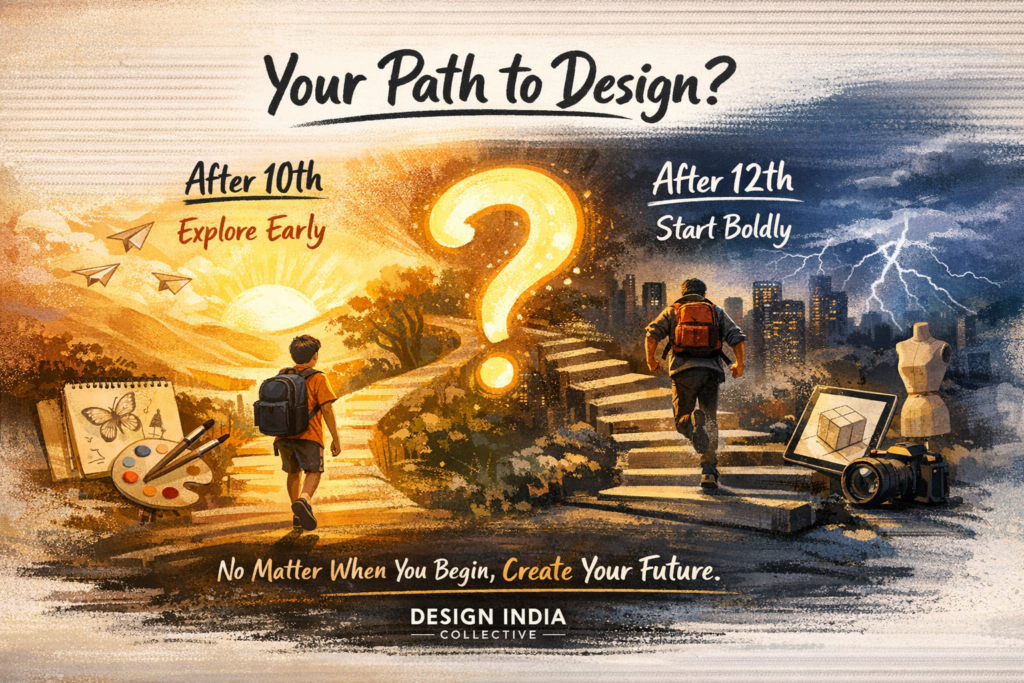
Some students step into design like a sunrise—slow, soft, and early. Others arrive like a storm—late, loud, and unstoppable. Both are valid. Both leave their mark. There is no perfect age to begin creating; there is only the moment you decide to listen to yourself. If you’re starting after the 10th, begin gently, with curiosity and consistency. If you’re starting after the 12th, begin boldly, with focus and courage. Design doesn’t judge your timeline—it responds to your honesty in the present.
Starting early or late is never the measure of success. What truly matters is your skill, intent, and willingness to grow. Many students come to design after exploring other fields—engineering, commerce, or entirely different paths—because creativity often finds its voice later. Design entrance exams don’t question where you began; they look at how far you’ve evolved in the time you had.
If you’re exploring your path into design, you can schedule a visit to Design India Collective to understand how your journey can move forward with clarity and confidence.